Mar 4, 2026
Ad Fatigue: What it is, Why it Happens, and How to Prevent it
Insights
•
John Gargiulo
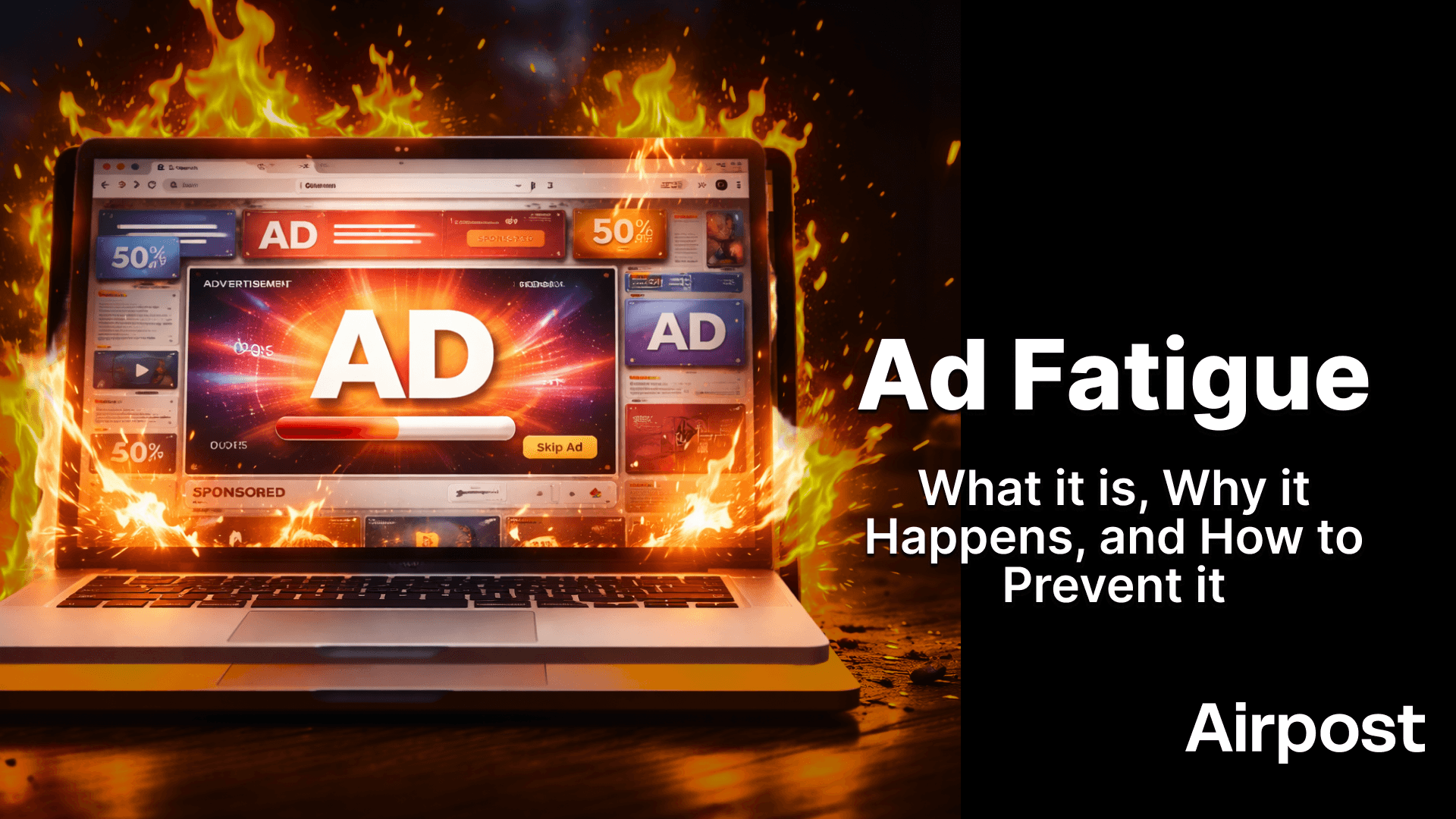
Ad fatigue is one of the most common reasons paid campaigns lose performance over time. It happens when your audience sees the same ad so many times that they stop noticing or responding to it. Performance metrics start declining (click-through rates drop, cost per acquisition rises, and engagement flatlines), not because the ad was bad, but because it's become invisible through repetition.
The good news is that it's predictable and preventable. But if you truly understand why it happens, and what to look for. In this article, we’ll break down why it happens, how to identify it in your data, and what to change before performance drops further.
Why does ad fatigue happen?
It comes down to how our brains are wired to prioritize novelty and filter out the familiar.
Habituation is the core mechanism.
Our brain constantly scans for new information that might be relevant or threatening. When it encounters the same stimulus repeatedly, it learns that this thing doesn't require attention anymore, so it's safe to ignore. The ad becomes part of the visual wallpaper, processed the same way you stop noticing the hum of an air conditioner.
Banner blindness is a learned behavior specific to digital environments.
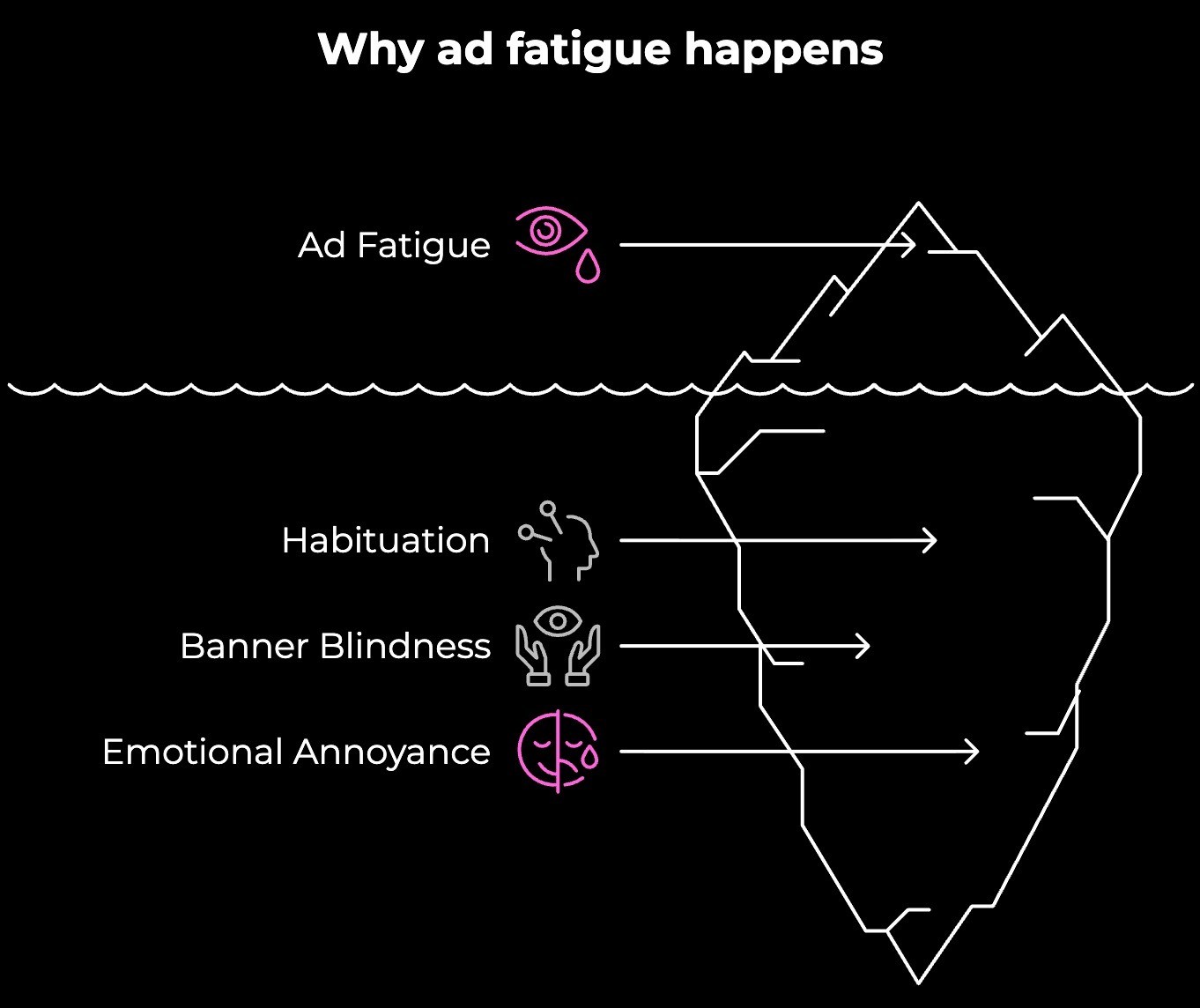
People have trained themselves over the years to instinctively skip over anything that looks or feels like an ad. The more they see your specific creative, the faster this filtering kicks in, even in highly visual categories like beauty ads where novelty matters.
There's also an emotional component. Seeing the same message repeatedly can shift from neutral to mildly annoying. What once felt relevant starts feeling like the brand is following you around, which creates negative associations rather than just indifference.
Consequences of Ad Fatigue
The consequences cascade through your entire campaign performance:
Rising costs
As fewer people engage, the platforms charge you more to reach the same outcomes. Your cost-per-click and cost-per-acquisition climb because the algorithm has to work harder to find people who'll respond.
Declining engagement
It shows up across metrics, such as lower click-through rates, fewer conversions, less time spent on landing pages. The people who do click are often less qualified because your best prospects already saw it, ignored it, and moved on.
Wasted budget
You're paying to show ads to people who've mentally checked out. Every impression on a fatigued audience is money that could've gone toward fresh creative or new segments.
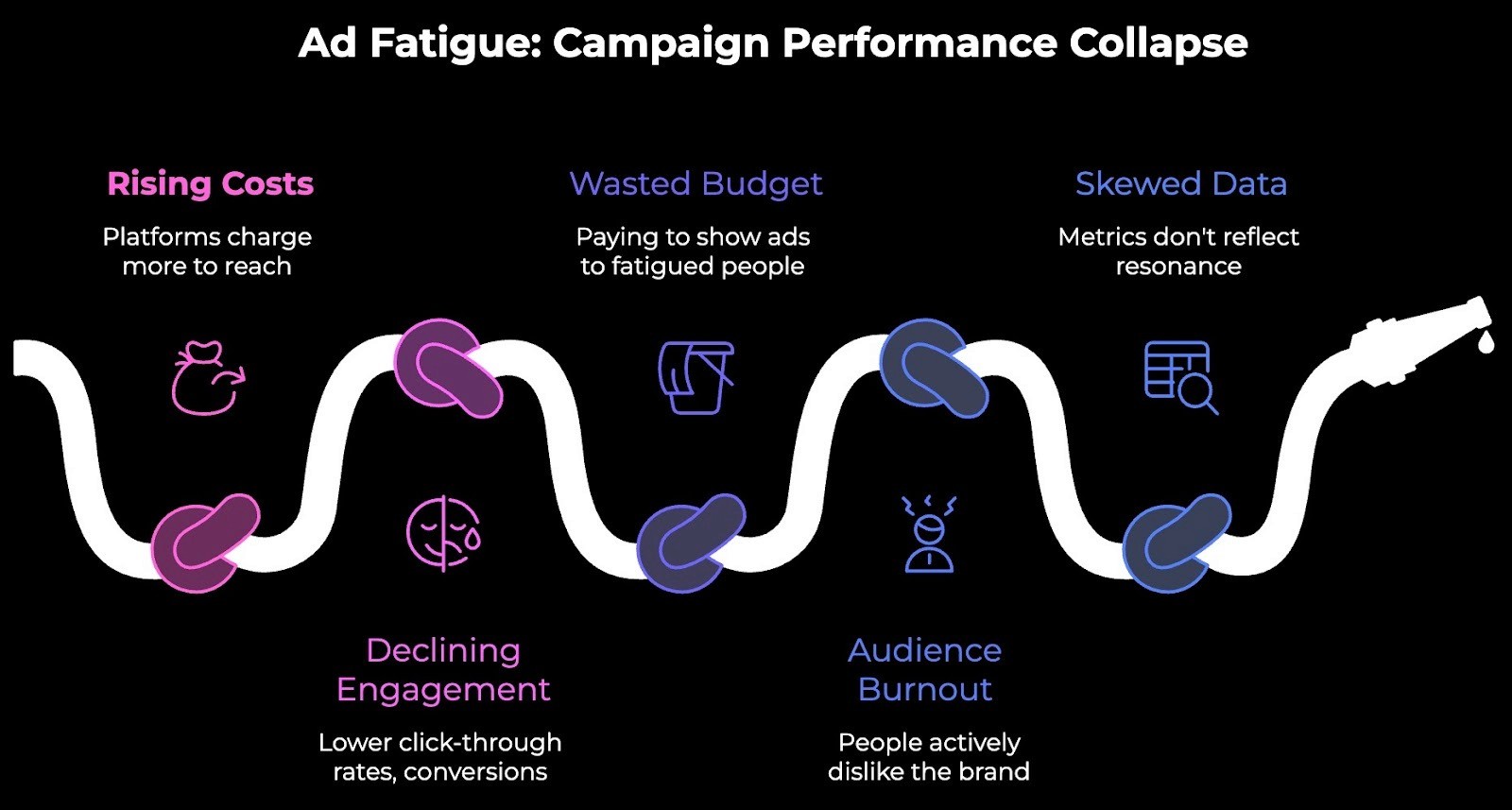
Audience burnout
This is harder to measure, but real. If you push too hard for too long, people don't just ignore you; they start actively disliking the brand. On LinkedIn, especially, where your audience is smaller and more professional, oversaturation can damage how people perceive your company.
People hide your ad, report it as repetitive, or mark it as irrelevant. This signals to the algorithm that your content is low quality, which tanks your relevance score and makes future delivery even more expensive.
Skewed data
When fatigue sets in, your metrics stop reflecting whether your message or offer resonates. They're just reflecting that people are tired of seeing it. You might kill a campaign that had a strong concept, not realizing the problem was frequency, not the creative itself.
Ad fatigue turns a working campaign into a leaky bucket where you're paying more to accomplish less while potentially souring your audience on your brand.
How to Prevent Ad Fatigue
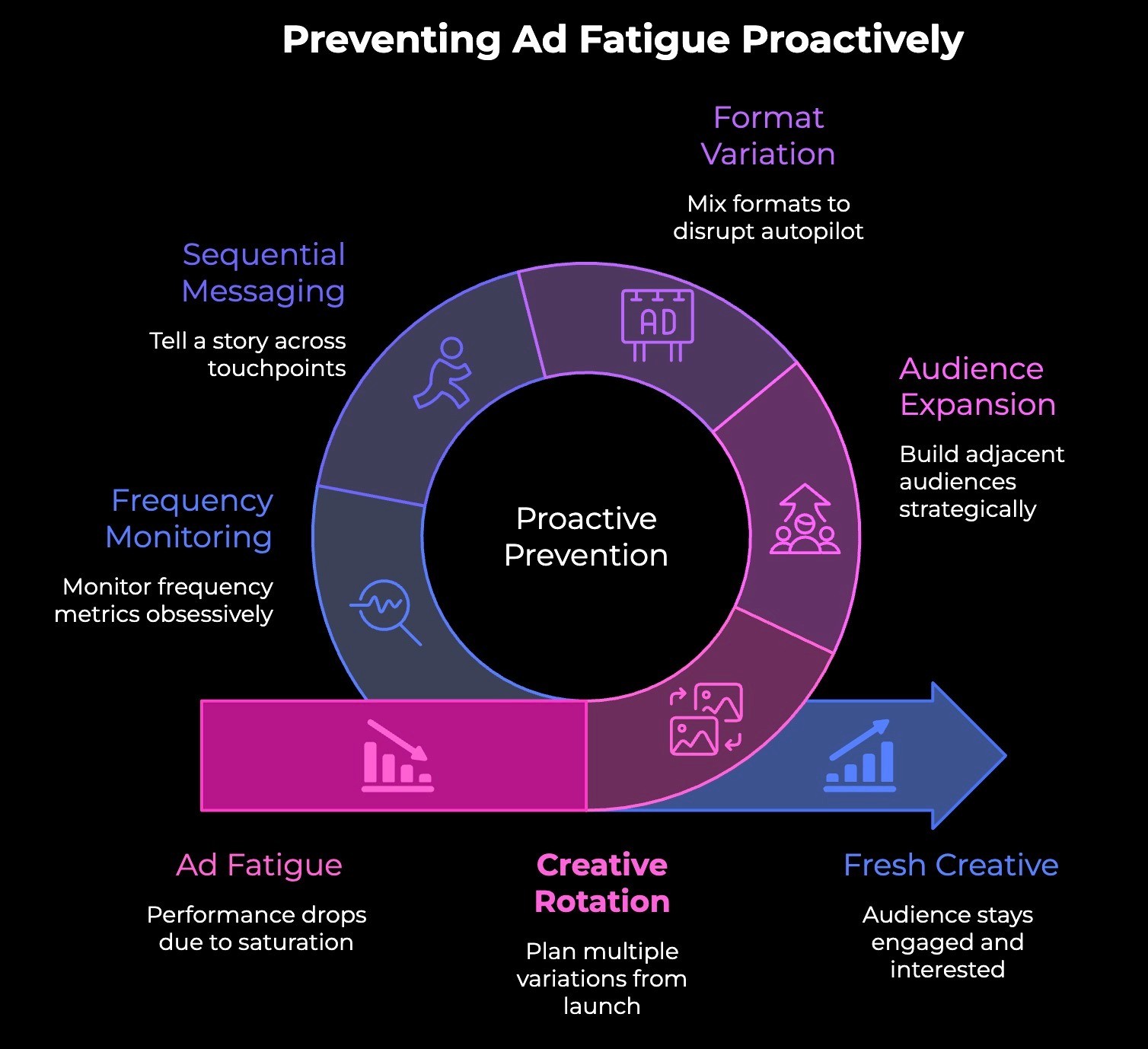
Ad fatigue isn’t something you fix after performance drops. It’s something you plan for in advance. The key is building systems that keep your creative, targeting, and messaging evolving before saturation sets in.
1. Build creative rotation into your process from day one
Most marketers treat creative refreshes as a reaction to declining performance, but by the time your metrics tank, the damage is already done. Instead, assume from the start that every piece of creativity has a shelf life. Plan for it the way you'd plan content calendars or email sequences.
This means having multiple variations ready before you even launch, whether you’re producing them in-house or using modern AI ad generators.
Here's what you can do:
Have 3-5 creative variations ready at launch
Set calendar reminders to review performance weekly
Treat creative production as ongoing, not one-and-done
Define your refresh triggers in advance (frequency hits 3, CTR drops 20% from peak)
Having these triggers defined keeps you proactive rather than scrambling when numbers start sliding.
2. Expand your audience strategically before saturation hits
When you target a narrow segment aggressively, you'll burn through that pool faster than you expect. This is especially true on LinkedIn, where professional audiences are already limited, or on Meta when you're going after a specific niche.
The solution isn't to abandon targeting precision. You have to build audience expansion into your strategy. Start with your core segment, but have adjacent audiences ready to activate.
Ways to expand without losing relevance:
Exclude people who've already converted
Build lookalike audiences based on your best converters
Identify adjacent job titles that still make sense for your product
Consider excluding those who've seen your ad 4+ times without engaging
This keeps your budget focused on people who haven't yet made a decision rather than hammering the same eyeballs repeatedly.
3. Vary the format, not just the message
People develop pattern recognition for specific ad formats. If every ad you run is a static image with text overlay, your audience will learn to scroll past that shape instinctively, even if you change the words and colors.
Mixing formats disrupts this autopilot behavior. Each format triggers different mental processing, so rotating between them extends how long your message stays fresh.
Formats to rotate through:
Static images (your baseline)
Carousels (require interaction, force engagement)
Video (movement captures attention in static feeds, especially when powered by modern AI tools for making video ads
Document ads on LinkedIn (feel more like content than advertising)
This also gives you data on what actually resonates versus what's just suffering from overexposure.
4. Tell a story across multiple touchpoints instead of repeating one message
The repetition problem isn't just about seeing the same ad. It's about hearing the same thing over and over with no progression. Your audience isn't static. They're learning, considering, and comparing options. Your ads should reflect that journey.
Sequential messaging treats your campaign like chapters rather than a single billboard.
How the progression might work:
Cold audience → awareness-focused message about the problem
Engaged viewers → deeper dive into your solution
Site visitors → customer proof, specific use cases
Cart abandoners → urgency or incentive
Each touchpoint adds to their understanding rather than repeating what they already know.
5. Monitor frequency metrics obsessively and act before performance drops
Frequency is how many times the average person sees your ad. And it is the canary in the coal mine. Most platforms surface this metric, but marketers often focus on clicks and conversions while ignoring the warning signs.
General frequency thresholds to watch:
2-3 on Meta or LinkedIn → start watching closely
5-6 → fatigue is almost certainly dragging down results
8+ → you're likely annoying people and wasting budget
The tricky part is that averages mask extremes. Some people might be seeing your ad ten times, while others have only seen it once.
Build frequency caps into your campaign settings where possible, and check these numbers weekly. When you see frequency climbing while engagement holds steady, you have a window to act. Refresh creative, expand audiences, or shift budget before the decline actually starts.
Keep Creative Velocity High with Airpost
Producing new concepts consistently takes time, coordination, and budget. When creative output slows down, fatigue sets in faster than you can react.
Airpost is built around solving that exact problem.
Instead of treating creativity as a one-off asset, it helps you generate and test new variations continuously. The platform combines AI production with expert creative strategists, so you’re not just producing more ads; you’re producing structured variations across hooks, personas, angles, and formats.
With a steady pipeline of new ads each week, you’re not waiting for performance to decline before making changes. You’re proactively refreshing creative, extending campaign lifespan, and keeping frequency from turning into fatigue.
Book a demo with Airpost to see how consistent creative rotation can help you stay ahead of ad fatigue and keep your campaigns performing.